Color Bus Trip
- 4.6
- Rating
- 1.00M
- Installs
- Free
- Price

 Analysis by App-foxy
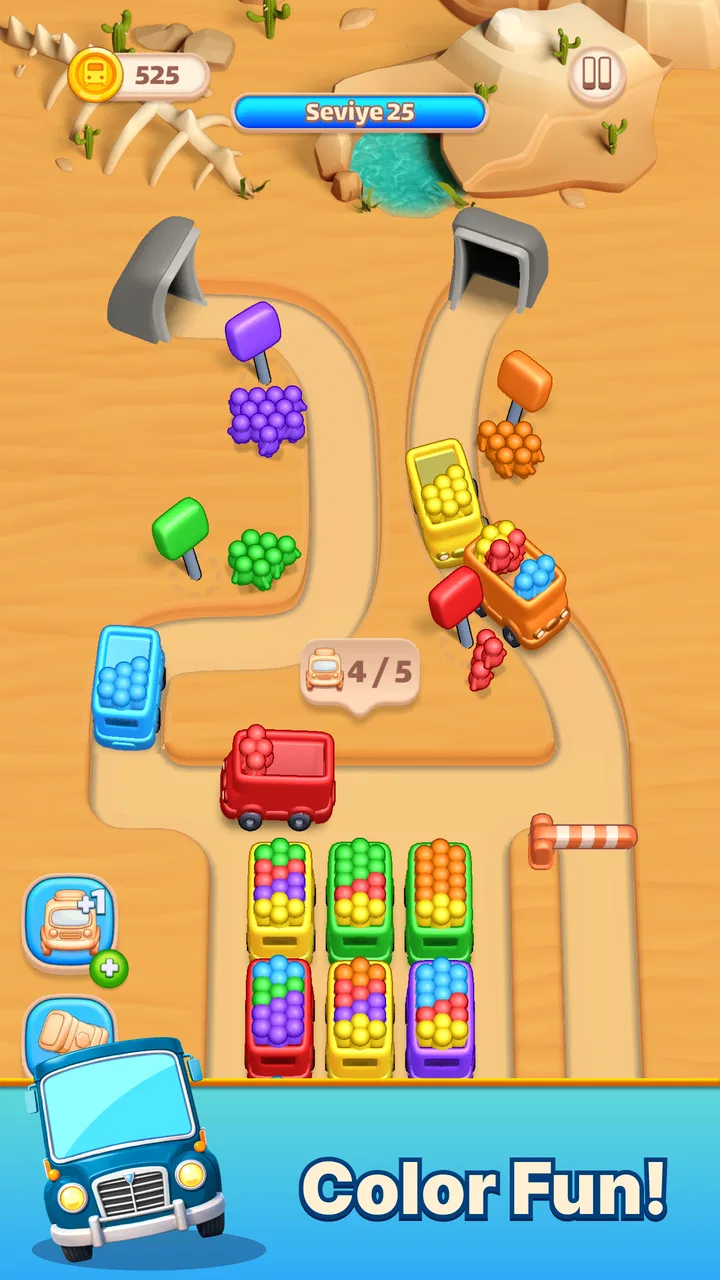
Color Bus Trip is a free puzzle game from VOODOO that turns a simple sorting idea into a surprisingly absorbing routine. I tap buses, match passengers by color, and try to complete pickups without letting the arrangement become impossible. The rules are easy to understand almost immediately, but the decisions become less automatic once several colors, waiting spaces, and bus choices compete for attention.
After spending time with it, I see the appeal clearly: this is designed for short sessions, quick restarts, and the pleasant feeling of making a messy board orderly. It is not a deep strategy game in the traditional sense, and it does not try to be one. Its strength is the small mental pause it creates between everyday tasks. If you enjoy compact sorting puzzles and want something that can be played with one hand, it is an easy game to consider. If you need a long-form challenge, a story, or precise information about how your performance is handled during extended play, you may find its simplicity limiting.
How the bus-sorting puzzle feels in everyday play
The central interaction is deliberately direct. I look at the colors on the board, decide which bus should move first, and tap it to collect the matching passengers. A successful choice gradually clears the scene, while a careless choice can leave useful colors blocked behind an awkward order. That makes each level feel like a small planning exercise rather than a reflex test.
You May Also Like

 Blood Strike: 2.5 Anniversary
Blood Strike’s Loadouts Turn Every Drop Into a Tactical Gamble
A close look at Blood Strike’s custom loadouts: how fast access to signature weapons reshapes its battle royale rhythm, rewards preparation, and narrows the gap between fights.

 Pandora - Music & Podcasts
Pandora’s Music Is Easy to Start, but Harder to Recover
Pandora’s strength is its low-effort path from a seed to a station. Its weak spot is how much confidence it asks you to place in connection, setup, and quiet recovery.

 8 Ball Pool
 Is Built on Rivalries, Rematches, and Routine
A close look at the rivalries, rematches, shared routines, and unanswered safety questions that turn a quick pool match into a persistent mobile community.

 Samsung Music
’s Quiet Strength Is Playing What You Already Own
Its reach comes less from spectacle than from dependable access to a personal library. That simplicity is both the app’s strongest retention engine and its ceiling.

 AccuWeather: Weather Radar
AccuWeather Review: A Quick, Clear Forecast for Everyday Decisions
For everyday plans, the best forecast is the one you can understand quickly. AccuWeather makes rain timing, radar, and local conditions easy to act on, with a few trade-offs.

 Hill Climb Racing
Why Hill Climb Racing Still Turns Crashes Into One More Run
A tiny car, a bumpy hill and one more upgrade: Hill Climb Racing keeps resurfacing because its simple chaos makes every near-miss feel personal.
More From Our News Desk



The first few moves are usually obvious, which helps the game work for casual players. The interest comes later, when I have to stop treating every available bus as equally useful. A bus that can collect passengers immediately may still be the wrong choice if it exposes a less helpful color or uses the space I need for a better sequence. The best moments come from recognizing that the safest move is not always the fastest-looking one.
I particularly like the way the game encourages me to scan the whole arrangement before tapping. That habit matters more than speed. On a crowded board, I can lose progress simply by focusing on the nearest match instead of checking what that move leaves behind. My practical advice is to identify the colors that are currently trapped or difficult to access, then work backward from them. This is more reliable than clearing whatever happens to be visible first.
That small change in approach is one of the less obvious strengths of the design. The game looks like a color-matching activity, but the useful skill is actually sequence planning under limited space. I do not need to memorize complicated rules; I need to preserve future options. Players who enjoy untangling arrangements will notice this quickly, while anyone expecting a pure tap-and-clear experience may be surprised by the occasional need to wait.
What makes the early game approachable
The Everyone age rating fits the accessible presentation and uncomplicated premise. I can hand the game to someone who rarely plays puzzles and explain the objective without a long tutorial. The free entry point also makes it easy to try without committing money at the start, although in-app purchases range from $1.99 to $99.99 per item. That range is worth keeping in mind if the game becomes part of a regular routine rather than an occasional pastime.
For a realistic everyday scenario, I would use it during a short wait at a bus stop, while a kettle boils, or between two appointments. A level can be approached as a contained task: inspect the colors, make a few careful taps, and stop when attention is needed elsewhere. I would not choose it for a commute where I need to remain fully alert, but it suits those small gaps when I want something more engaging than scrolling.
The game is also a good fit for players who prefer visual decisions over text-heavy instructions. There is no need to follow a narrative or remember a large set of objectives. The board itself tells me what matters. That clarity reduces the mental overhead and helps explain why the game has attracted over 1M installs and an average rating of 4.6 from around 11K ratings.
Where the challenge comes from
The challenge is not simply matching one color to another. It is choosing an order that keeps the remaining board workable. I often find myself separating moves into three groups: immediate matches, moves that reveal something useful, and moves that should be postponed. That mental classification is a practical way to avoid wasting a valuable opening.
One useful tactic is to treat open space as a resource rather than an empty area. If a move leaves the board visually cleaner but removes flexibility, it may be worse than a move that looks slower and preserves room for later buses. I also try not to commit to a color just because it has a visible passenger waiting. The more important question is whether that bus helps unlock the next decision.
Another tip is to pause after every meaningful change in the arrangement. Rapid tapping can make the board feel more confusing because I am planning from an outdated picture. A short inspection after a bus leaves gives me a chance to notice newly available colors and avoid following a plan that no longer fits. This is especially helpful for players who normally solve puzzles by acting quickly.
These habits make the game more satisfying, but they also reveal its limits. The mechanics remain narrow. There is no reason to expect the variety of a large logic-puzzle collection, and players who want elaborate rule combinations may outgrow it. Its appeal depends on whether repeating a clean sorting loop feels relaxing or repetitive to you.
Speed, stability, and practical device expectations
From a player’s perspective, the game is built around quick responses rather than lengthy sessions of continuous action. The important performance question is not whether it delivers cinematic graphics; it is whether taps feel immediate enough for a puzzle where one mistaken selection can spoil the intended sequence. The restrained visual concept gives it a sensible foundation for that kind of play, though the experience can still depend on the phone or tablet being used.
I would expect the game to feel most comfortable on a reasonably maintained device that meets its minimum requirement of Android 8.0 or later. That requirement is not especially demanding, so it should suit a broad range of Android hardware. Still, meeting the operating-system requirement does not guarantee identical behavior on every device. Older phones may have less room for other apps, and a device already struggling with heat or background activity can make any game feel less responsive.
For short puzzle sessions, perceived speed comes mainly from the clarity of the board and the timing of the tap response. I do not need a high frame rate in the same way I would for an action game, but I do need the interface to keep up with deliberate choices. If the phone is busy with other work, I would close unused apps, let the device cool down, and avoid judging the game during a moment when the entire system is under strain.
Heavy-use moments are more likely to appear when I play repeatedly rather than during one isolated level. A short session may feel light because the game is visually simple, but extended play can expose ordinary device constraints such as battery drain, heat, or slower switching between the game and other apps. I cannot treat those effects as a fixed property of every installation, so I see them as reasons to test the game on the device I actually plan to use.
My preferred workflow is to play a few levels, lock the screen, and return later instead of leaving the game open for long periods. That approach is practical for a casual puzzle and also gives me a better sense of whether the device resumes the game comfortably. If I am using an older phone, I would avoid running it alongside several demanding apps and would keep expectations modest during long uninterrupted sessions.
Recovery after interruptions
Interruptions are part of the game’s natural use case. A message, phone call, or change in surroundings can pull me away halfway through a sorting decision. The safest habit is to stop after a completed move or a clear pause in the board rather than leaving the game during a rapid sequence of taps. That reduces the chance that I return without remembering which colors I had intended to preserve.
I also recommend treating a restart as a normal part of learning rather than as a failure. Puzzle boards can become difficult to read once I have made several poor choices, and continuing stubbornly may be less useful than beginning again with a better order. The recovery loop is therefore psychological as much as technical: the game works best when I accept that an early mistake can teach me which color should have been protected.
Players who need guaranteed progress recovery after every interruption should approach it carefully and test their own routine before relying on it during important downtime. I would not start a level when I know I may need to put the phone away immediately. A sorting puzzle rewards attention, and even a short interruption can change how clearly I remember the board.
Resource demands and device fit
The simple visual style makes this a more sensible choice than a graphically intense game for a modest Android phone, but “simple” does not mean every device will behave identically. Storage space, background processes, battery condition, and the phone’s general age all matter. The current version is 1.18.0, and keeping the operating system and app environment in good condition is the most sensible way to reduce avoidable friction.
I would recommend it to someone who wants a low-commitment puzzle on a phone that is not built for demanding 3D games. I would be more cautious with a device that already overheats, closes apps unexpectedly, or has very little free storage. Those problems can make a calm puzzle feel frustrating even when the game itself is not visually complex.
There is also a personal resource cost: attention. Because the rules are easy, I may assume I can play while doing something else, but the later choices deserve concentration. This is not a game I would use while walking, cycling, or handling work that requires accuracy. Its relaxed appearance can disguise the fact that a single distracted tap may send the board in an unwanted direction.
How it compares with other puzzle choices
Compared with classic match-three games, this feels less dependent on creating chains and more dependent on preserving an order. Match-three alternatives are often better when I want quick visual rewards, special pieces, or a board that changes dramatically after each move. Color Bus Trip is better when I want to inspect a situation and solve it with a controlled sequence.
Compared with traditional Sudoku or nonogram apps, it is faster to understand and more tactile, but it offers less room for long-form deduction. Sudoku gives me a stable grid and a large set of logical relationships; this game gives me a moving arrangement where the order of actions is the main concern. I would choose Sudoku for a quiet, focused session and this game for a lighter, more immediate break.
It also differs from word puzzles because there is no vocabulary barrier. That makes it easier to share with family members who prefer visual games, though it may feel less rewarding to people who want knowledge, language, or a strong sense of progression. The right alternative depends on whether I want sorting satisfaction, formal logic, or rapid matching.
The purchase structure is another practical comparison point. Since the game is free to start but offers individual in-app purchases between $1.99 and $99.99, I would decide in advance whether I am comfortable spending anything. For a child’s device, the Everyone rating is reassuring in terms of the intended age audience, but I would still use the device’s purchase controls rather than assuming casual play can never lead to an unwanted transaction.
Who should play it, and who should skip it
I think it is a strong match for casual puzzle players who enjoy organizing visual clutter, making careful choices, and finishing small tasks. It is also suitable for someone who wants a game that can be understood quickly without reading a long rulebook. The bus theme gives the sorting routine a recognizable shape, while the color focus keeps the interaction approachable.
I would recommend skipping it if you need a rich story, competitive multiplayer, detailed character development, or a puzzle system that changes substantially from one session to the next. It is not the right replacement for a serious logic app, nor would I pick it for a long flight if I wanted a deep game capable of holding my attention for hours without repetition.
Players with color-vision difficulties should consider how comfortably they can distinguish the game’s visual cues before investing time or money. Because color matching is central, the experience depends heavily on recognizing those distinctions. I would also avoid recommending it as a background game for someone who prefers to multitask, since the most interesting decisions require looking ahead rather than tapping automatically.
My performance verdict
My overall view is positive, with realistic expectations. Color Bus Trip succeeds because it makes a narrow idea pleasant: choose the right bus, match the right passengers, and keep the remaining board open for the next decision. Its perceived speed should suit casual play, its minimum Android requirement is approachable, and its visual simplicity makes it a reasonable candidate for less powerful devices. At the same time, extended sessions may feel repetitive, and the best experience still depends on the condition of the phone and the player’s willingness to focus.
The most valuable way to play is not to rush. I get better results when I inspect difficult colors first, preserve open space, and pause after each important move. Those small habits turn the game from random tapping into a compact logic exercise. They also make it easier to decide whether the core loop genuinely suits me before considering any purchase.
VOODOO has made a free puzzle that is easy to pick up and surprisingly good at filling short breaks. Its 4.6 average from roughly 11K ratings suggests that the straightforward formula connects with many players, while the 382 reviews show that it has generated substantial written feedback as well. I would recommend trying it to anyone who likes tidy visual problems and short, repeatable sessions. I would choose a deeper logic title instead for extended concentration, but for a quick mental reset, Color Bus Trip earns a place on my shortlist.
FAQs for Color Bus Trip
01What is Color Bus Trip and how does the game work?
Color Bus Trip is a casual puzzle game centered on organizing colorful passengers and buses. The main objective is usually to match passengers with the correct bus colors while managing limited space, movement order, and level-specific obstacles. As you progress, puzzles become more challenging and require planning rather than simply tapping quickly. It is designed for short play sessions and is easy to understand for new players.
02Is Color Bus Trip free to download and play?
Color Bus Trip can generally be downloaded for free on supported Android or iOS devices, but the game may include optional in-app purchases. These purchases can provide extra hints, boosters, lives, coins, or other conveniences. You should also expect advertisements in some parts of the game, particularly between levels or when requesting rewards. The core puzzle experience is usually available without paying, although progress may be slower.
03Does Color Bus Trip require an internet connection?
The basic puzzle levels in Color Bus Trip may be playable without a constant internet connection, which makes the game convenient for travel or offline moments. However, certain features can depend on connectivity, including advertisements, cloud saving, online events, updates, leaderboards, and in-app purchases. Availability may vary according to the version installed and your device, so it is best to open the game online at least occasionally.
04Is Color Bus Trip suitable for children and casual players?
Color Bus Trip is aimed at casual players and uses simple controls, colorful visuals, and straightforward matching mechanics. Younger players may enjoy the accessible gameplay, but parents should still review the app-store age rating and privacy information before installation. Advertisements and optional purchases can also appear, so parental controls may be useful. Later puzzles can require patience and careful planning, even though the basic rules are easy to learn.
05What should I check before installing Color Bus Trip?
Before installing Color Bus Trip, check that your Android or iOS device meets the current system requirements and has enough free storage for the game and future updates. Review the permissions requested, privacy policy, advertising practices, and in-app purchase information. It is also worth confirming whether your progress can be synchronized between devices. Because features and availability may change through updates, read the latest store description and user reviews before downloading.
Pros
- Simple controls make it easy to start playing immediately.
- Short levels are convenient for quick gaming sessions.
- Colorful visuals give the game a cheerful
- accessible style.
- Progressive challenges help maintain interest beyond the first levels.
- Offline play is useful when traveling or without an internet connection.
Cons
- Repeated level patterns may make the gameplay feel predictable over time.
- Some puzzles can depend more on trial and error than careful planning.
- Ad interruptions may reduce the smoothness of longer play sessions.
- The game may feel too simple for players seeking deep strategy.
- Limited customization can make progression feel less personal.

Color Bus Trip
Gallery